
Organising a company conference means sharing one direction with all your teams, on the same day, then giving them the floor. Eight steps lead there: objective, format, date, venue, programme, stage, welcome and follow-up. Here are the method, the conference timeline and the planning checklist.
Has the conference landed on your desk, on top of your job? With Weevup, the split is clear: you decide, we do the rest. As a conference organiser, our agency supported Toupret and its 150 employees gathered in Sénart, as well as the AFCDP, in Paris, with around 950 participants.
- A conference starts with a message, then an audience: the venue and the date come next.
- Eight steps, from scoping to follow-up, with a dedicated project manager.
- A conference timeline in seven phases, set to your calendar.
- A programme that answers four questions: where are we going, what does it change, can I respond, and with whom?
- With 300, 500 or 1,000 people, it all comes down to flow: arriving, hearing, talking, leaving.
Where do you start when organising a company conference?
To organise a company conference, start with a single sentence: what the room must have understood on the way out. The audience, the timing and the tone are settled next, before anyone even mentions the venue.
The message
A new direction, a review of the year, an offer, a merger, an anniversary: one strong idea per conference. We rework it with you until it fits on one line.
The audience
Head office, sites, sales teams, subsidiaries: where do they come from, what do they already know, which language do they work in? The answers guide the city, the timings and the format.
The tone
Formal, studious, warm, festive: the tone colours the invitation, the stage and the evening. We show you several directions.
The decision
Management, communications, human resources, procurement: we present clear options, with an itemised cost estimate, so that everyone can decide easily.
Still unsure about the format? Our article on the difference between a seminar and a conference helps you decide. Have you already written an event brief? We start from it. Otherwise, one conversation is enough: we are the ones who write the brief.
How do you organise a company conference in 8 steps?
Organising a corporate conference follows eight steps, from scoping to follow-up. At each one, your dedicated project manager, your Weever, prepares the options; you choose, we make it happen.
- The objective. We write it with you, along with two or three signs that will show, afterwards, whether the conference has paid off.
- The format. Half a day, a day that runs into the evening, two days; the whole company, a network or managers only, as in our managers’ conference guide.
- The date. We cross-check your internal calendar, school holidays, the trade shows in your sector and venue availability.
- The venue. We compare several addresses, presented with the whole project: plenary, workshops, access, meals. Our starting points: conference venue ideas and the corporate convention in Paris.
- The programme. We write the running order, the sequence of speakers, the breaks and the time for discussion. Your management team approves it.
- The stage and the technical set-up. Set, sound, lighting, screens, streaming: our event scenography agency designs the room, then we fix the cue sheet and the rehearsals.
- The welcome and the logistics. Invitations, registration, badges, signage, travel, rooms, meals: everyone knows where to go, without your phone ringing.
- The big day and what follows. Our team runs the welcome and the control desk, and handles the unexpected. Then come the images, the workshop summary and the participants’ feedback.

Groupe Positive: 300 participants in Brussels
Participants travelling from afar, rooms to transform quickly, plenary sessions, team meetings, a team building activity, then an anniversary party. We followed every journey to the Plaza Hotel and linked all the highlights together.
What does a conference timeline look like?
A conference planning timeline starts from the big day and works back to today, decision by decision. Ours has seven phases, and their length adjusts to your calendar.
| Phase | What you decide | What we do |
|---|---|---|
| Scoping | The message, the audience, the period | Taking the brief, the main options, a first cost estimate |
| Venue and date | Your favourite venue among our suggestions | The search, the site visits, the options, the reservation |
| Programme and theme | The angle, the speakers | The running order, the name, the visual identity, the entertainment |
| Invitations | The tone, the groups invited | The invitation, registration, travel, rooms |
| Production | The final choices of set and menu | The stage, the technical set-up, the meals, the signage |
| Rehearsals | The messages delivered on stage | The cue sheet, each speaker’s run-through, the control desk |
| The big day and after | What happens next | The welcome, the coordination, the review, the sharing of images |
Two decisions drive all the others: the date and the venue. Once they are set, everything moves forward in parallel, from the programme to travel. So as soon as the scoping is done, that is where we start.
A conference timeline is a living document: speakers change, a message evolves, and we adjust what follows. For other formats, see where to start with a corporate event and our steps to organise a corporate retreat.
What should a company conference programme include?
A company conference programme answers the four questions each participant asks, sitting in the room. We build it in that order, so that people keep listening until the evening.
- Where are we going? The plenary session: management speaks briefly, with images, and one message per talk.
- What does it change for me? Stories from colleagues, then workshops, job by job.
- Can I respond? Questions in small groups, votes, a roving microphone. Quizzes, polls and games: our conference entertainment ideas.
- With whom? A lunch that mixes departments, a team building activity for large groups, an evening event.
For timings, read our sample company conference agenda, hour by hour. For an outside voice, see how to choose a keynote speaker.
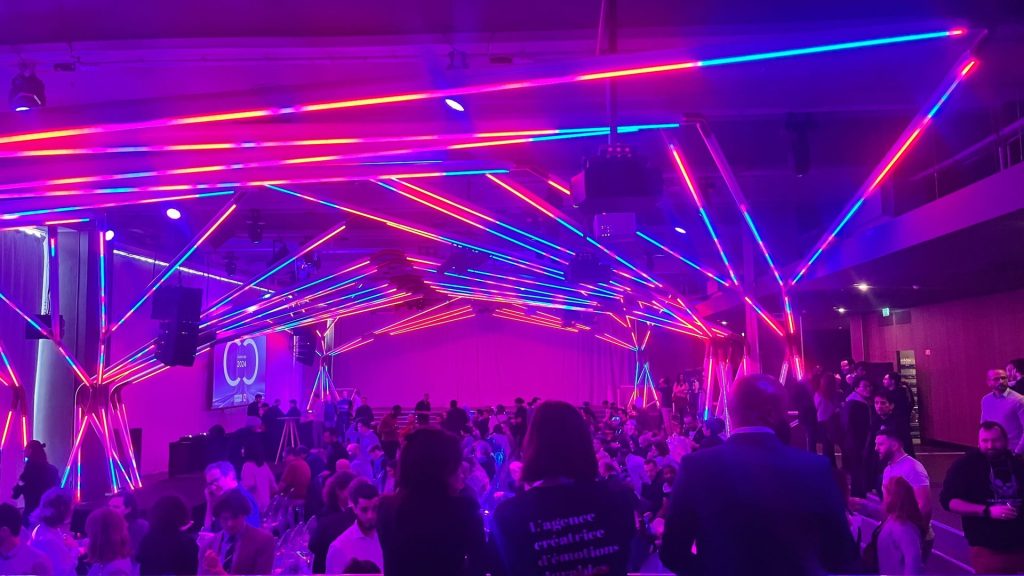
3DS Outscale: a conference at a different time of day
For 340 participants, we shifted the annual conference: it began at 1 pm and ended at midnight, at the T7. Ten groups of around thirty people questioned the members of the executive committee, and a Burger Quiz livened up the plenary.
What are good company conference themes?
Good conference themes turn your message into an image, found again from the invitation to the stage. A theme is chosen after the message, never before.
The course
For a new strategy: a map, a compass, stages. Cap 30 Connect, the Toupret conference, carried the word in its name: “cap” is French for course.
The crew
For a merger, or teams who barely know each other: a boat, an orchestra, a roped climbing party, and workshops in mixed teams.
Behind the scenes
To showcase people’s jobs: a workshop, a building site, a day told by those who live it.
On the ground
To bring head office and the regions closer: colleagues step on stage, management listens and takes notes.
The anniversary
To celebrate a milestone: a timeline, archives, faces, then the chapter still to be written. Our company anniversary ideas.
Tomorrow
For a transformation: demonstrations to try out, stands, a debate between professions.
A theme lives through its details. For the AFCDP, one identity dressed the banners, the brochure, the signage, the jingle and the projected presentation, with reusable three-dimensional letters. All of it was the work of our event communication agency.
How do you organise a conference for 300, 500 or 1,000 people?
With 300, 500 or 1,000 people, the steps are identical; what changes is the flow. We organise conferences of every size, the largest included, with more than 1,000 participants.
| Your conference | What becomes decisive | Our examples |
|---|---|---|
| 150 people | One venue for everything, a stage close to the audience | Toupret, in Sénart, with European teams connected online |
| 300 people | Workshop rooms side by side, breaks that flow | Groupe Positive in Brussels, 3DS Outscale at the T7 (340) |
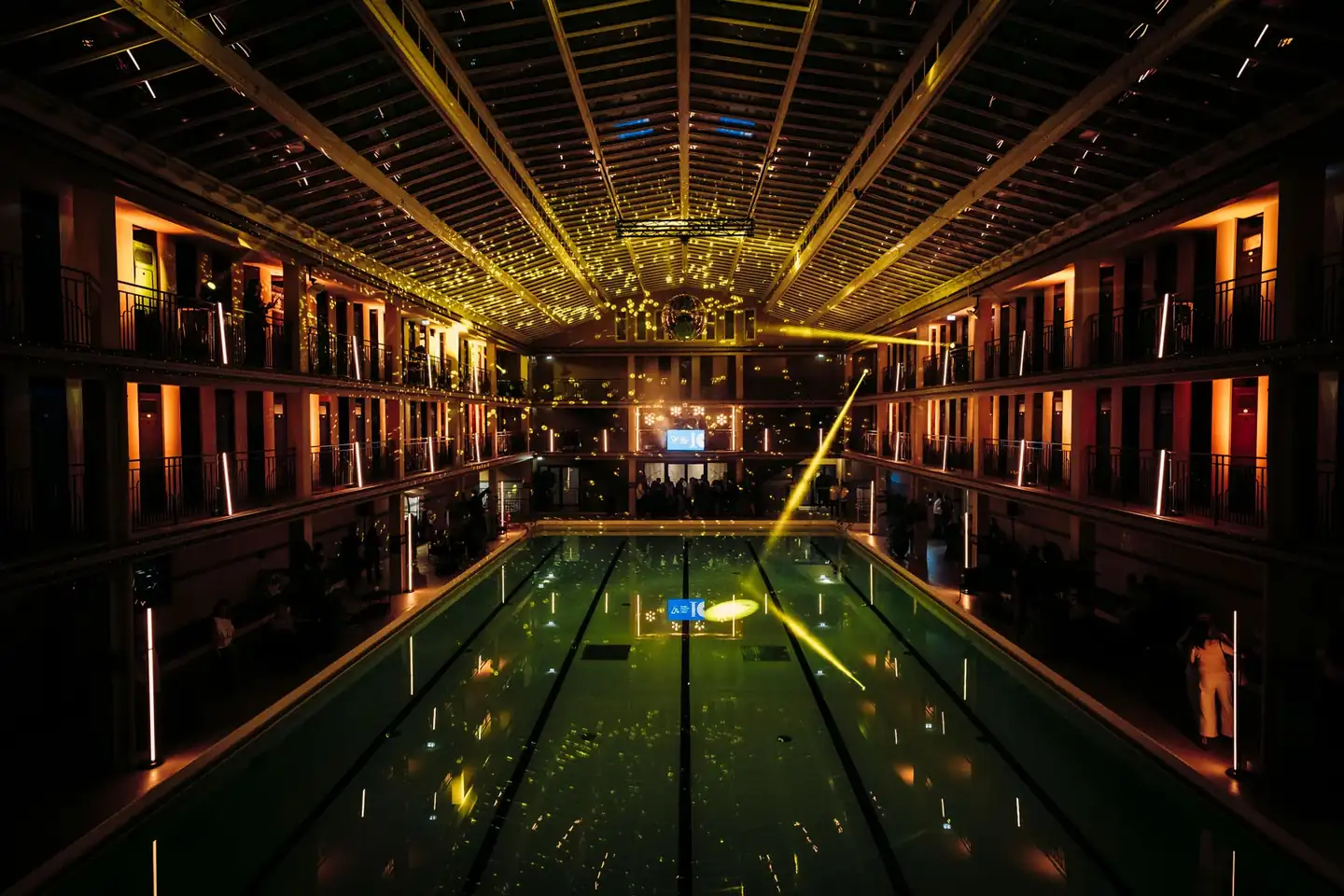
| 500 people | Several welcome points, screens that can be read from the back row, meals served quickly | For evening events, Scalian at the Molitor (400) and KPMG at the Aquarium de Paris (700) |
| 1,000 people and more | Check-in on tablets, flows, shuttles, a reinforced control desk | The AFCDP at the Maison de la Chimie (around 950), KPMG at the Lac d’Ailette (900, for a corporate retreat) |

AFCDP: around 950 participants checked in on time
At the Maison de la Chimie, ten tablets and 15 hosts made it possible to check everyone in before the first talk, and 16 stands were set up that same morning. During the day, the team passed the microphones around.
Beyond a few hundred people, travel matters as much as the stage. At the KPMG retreat, with 900 participants, shuttles ran continuously, on arrival and on departure. For the 350 employees of Elanco, the retreat linked Strasbourg, Huningue and Colmar.
How do you organise an annual company conference?
An annual company conference is planned as an eagerly awaited date: a fixed point in the year, in a form that changes each time. We start from the last edition, from what people liked and what they tired of.
- At the start of the year, it sets the pace: see our kick-off ideas and the New Year company event.
- Before the summer, it says thank you and prepares what comes next: our article on the pre-summer company conference.
- In September, it re-energises people: our comparison of a cultural venue and a traditional conference room.
- At the end of the year, it readily turns into a celebration, like an end of year corporate retreat.
For a sales network, the annual conference becomes a sales conference: offers, targets, awards. The format can also come to you: Scalian’s annual kick-off welcomed 280 participants to its offices in Neuilly.
How do you bring several sites, countries or languages together?
There are two ways: bring everyone to one place, or link the room to teams online. In both cases, everyone must be able to follow in their own language and take the floor.
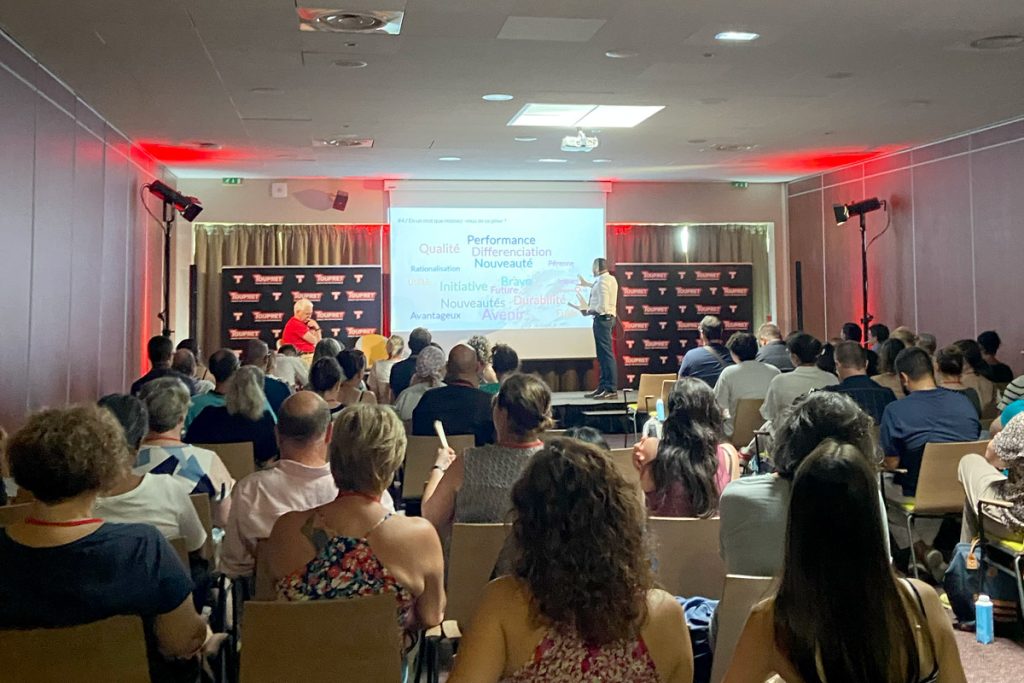
Toupret: a hybrid conference in four languages
In the room in Sénart, 150 employees; online, teams from Spain, Poland, the United Kingdom and the Benelux countries. Simultaneous translation by artificial intelligence, four presentations projected in parallel and shared polls.
The format kept evolving until the end; we reinforced the technical teams to keep the broadcast on track. Our article on the international hybrid event explains the set-up in detail.
What are the best practices for organising a corporate conference?
The best practices for a conference come down to one principle: respect the room’s attention. Here are seven, with the mistake that each one avoids.
- One idea, not ten. Too many messages, and everyone leaves with their own.
- Short talks. When they run on, the phones come out. We alternate voices, images and discussion.
- A rehearsal for everyone. Discovering the microphone live makes even the most confident lose their thread.
- The floor to the room from the morning. Questions kept for the end often go unanswered.
- A welcome without queues. Too long a wait wears out enthusiasm before the opening.
- A plan B for every sensitive point. Weather, a late train, an absent speaker, a breakdown: the answer is ready.
- A next step announced on stage. Without another date to look forward to, momentum fades back at the office.
An eighth is close to our hearts: choosing more responsible options. In our proposals, a heart marks venues served by train, seasonal produce or reused sets. You keep the ones that speak to you, with our approach as a CSR event agency.
What goes on a conference planning checklist?
This conference planning checklist covers what our team checks before the doors open. Use it as a reference; the checks themselves are our job.
- Message, running order and cue sheet approved by management.
- Venue confirmed, floor plan, exits and access for all verified.
- Sound, lighting, screens and connection tested from the back row.
- Rehearsals done, presentations and videos loaded at the control desk.
- Badges, check-in, cloakroom and signage in place.
- Travel, shuttles and rooms confirmed, arrivals list kept current.
- Meals, special diets and breaks agreed with the kitchens.
- Workshop and evening teams briefed, equipment counted.
- Photos, video and closing questionnaire ready to go.
Why use an agency to organise your company conference?
Because a conference brings many trades together for a few hours, and you already have your own job. An agency holds them together: one contact, one calendar, one itemised cost estimate.
More than 200 corporate events bear the Weevup signature, in France and abroad. Our team also works in English and Spanish, and takes care of everything, until the last participant has left. To compare, see how to choose an event agency.
Organising a company conference: frequently asked questions
It depends on the size, the venue and the season: large rooms and the most sought-after dates go first. The earlier the project starts, the wider the choice. And if your date is close, we fit in with your calendar and go straight to the decisions that count.
The budget depends on the number of participants, the venue, the technical set-up, the meals, travel and the evening. Weevup takes your brief with you, then presents an itemised cost estimate: you see what weighs most and what can be trimmed without touching the message.
Usually internal communications, human resources or an executive assistant, with a member of management who carries the message. The agency takes over the rest: venue, programme, stage, welcome, logistics and coordination on the big day.
Half a day or several days, depending on the message and the travel involved. Toupret’s hybrid conference lasted half a day, 3DS Outscale’s ran from 1 pm to midnight, and Groupe Positive’s, in Brussels, lasted three days.
With a plenary room of the right size, several welcome points, rotating workshops and meals served at several stations. Weevup maps out the flows on the floor plan, reinforces the team on site and arranges the transfers: at the Lac d’Ailette, the 900 participants in a KPMG retreat had continuous shuttles.
Start from the message, then look for a short word, easy to say aloud and to translate. The name must fit on a badge and on a screen. Toupret’s hybrid conference was called Cap 30 Connect. We suggest several names, with the visual identity to match.
By going back to the objective set at the start: messages remembered, questions asked, ideas from the workshops, the will to act. A short questionnaire on the way out and feedback from managers are enough. We prepare the tool and the summary.
Your company conference with Weevup
Weevup, a corporate event agency based in Le Vésinet (Yvelines), organises your conferences, plenary sessions, kick-offs, corporate retreats and evening events, in Paris, across France and abroad. EcoVadis silver medal (June 2026).