
Sustainable event suppliers, environmentally friendly and socially committed, can be recognised by criteria you can check: a label awarded by an independent body, practices set out in black and white in the quote, and precise information on products and journeys.
At Weevup, we offer you this checklist, from the venue to the caterer: you select with us the criteria that matter for your event.
EcoVadis assessed our approach on four themes, including sustainable procurement, alongside the environment, social issues and ethics: it was awarded the EcoVadis silver medal (June 2026).
For CSR at our corporate events, this translates into practical options, presented in every proposal as “positive notes” flagged with a heart: you choose the ones that suit you.
- A verifiable criterion is worth more than a promise: a named label, a written practice, precise information.
- The venue: train access, a third-party label, everything in one place.
- The caterer: seasonal produce, vegetarian dishes, adjusted quantities, a solution for unserved dishes.
- Transport, decor and goodies: group travel, hire, reuse, useful goodies or none at all.
- Example: the KPMG seminar at Center Parcs Lac d’Ailette, with local suppliers.
What is a sustainable event supplier?
For us, it is a supplier whose practices can be checked. An adjective is not enough: what counts is what the supplier can show, write into its quote or prove with a label. Here is how we turn your expectations into practical criteria.
| What you are looking for | What proves it |
|---|---|
| A venue that limits its impact | An environmental label awarded by an independent body, with its exact name, scope and date |
| Seasonal meals | A menu that follows the seasons, plenty of vegetarian dishes and the origin of the produce stated |
| Less waste | Quantities matched to the exact number of guests and a written solution for unserved dishes |
| Well-planned travel | Train access, group transfers and vehicles sized to the group |
| Understated decor | The share that is hired or reused, and what happens to the decor after the event |
| A social dimension | A named social-impact partner: an ESAT (sheltered work organisation), a social caterer, an inclusive business |
Which sustainability criteria should you check for the venue and caterer?
The venue and the caterer account for a large share of the choices behind an event. Here are the criteria to check for each.
- Direct train access or public transport, and the option of getting around on foot on site.
- An environmental label awarded by a third party, for example Green Key or the EU Ecolabel for accommodation, or ISO 14001 certification, with its scope and validity date.
- Spaces that let you do everything in one place: meetings, meals, evening event and accommodation.
- Natural light, and heating or air conditioning that can be adjusted room by room.
- Accessibility for people with reduced mobility, checked on site.
- The origin of the produce, a seasonal menu and producers from the region where possible.
- Plenty of vegetarian dishes, with tasty food served to everyone.
- Quantities adjusted to the exact number of guests and their dietary requirements.
- A solution for unserved dishes: we can also suggest a partner charity that collects them for redistribution.
- A possible social dimension: a social caterer, for example with refugee cooks, or a coffee break served by a business that employs people with disabilities.
The choice of venue also shapes your guests’ journeys: see how to choose a corporate retreat venue.
Which criteria apply to transport, decor and goodies?
- Group travel: a coach or shuttle between the station, the hotel and the venue.
- Shuttle runs timed to train arrival times.
- The type of vehicle and a capacity suited to the size of the group.
- On-site options for getting around on foot or by bike.
- Hired or reused furniture and decor, and a planned donation for anything that will not be reused.
- Technical equipment sized to what is actually needed.
- Digital invitations, badges and programmes where possible.
- Useful goodies, regional produce, welcome packs prepared by an ESAT, a gift voucher donated to a charity, or no goodies at all: our ideas for goodies your guests will keep.
How do you compare proposals from sustainable event suppliers?
The simplest way is to compare what is written down. A practice written into the quote can be checked on the day; an intention remains an intention. Here are the questions to ask each supplier; if you wish, we ask them for you:
- The label. What is its exact name, who awards it, what does it cover and until when is it valid?
- The practices. Which ones appear in the quote: origin of the produce, hired equipment, a solution for leftover food?
- The data. What information can the supplier share after the event: meals served, hotel nights, equipment transported?
If you wish, your Weever, the project manager who supports you at Weevup, then gathers this data with you to measure an event’s carbon footprint, item by item.
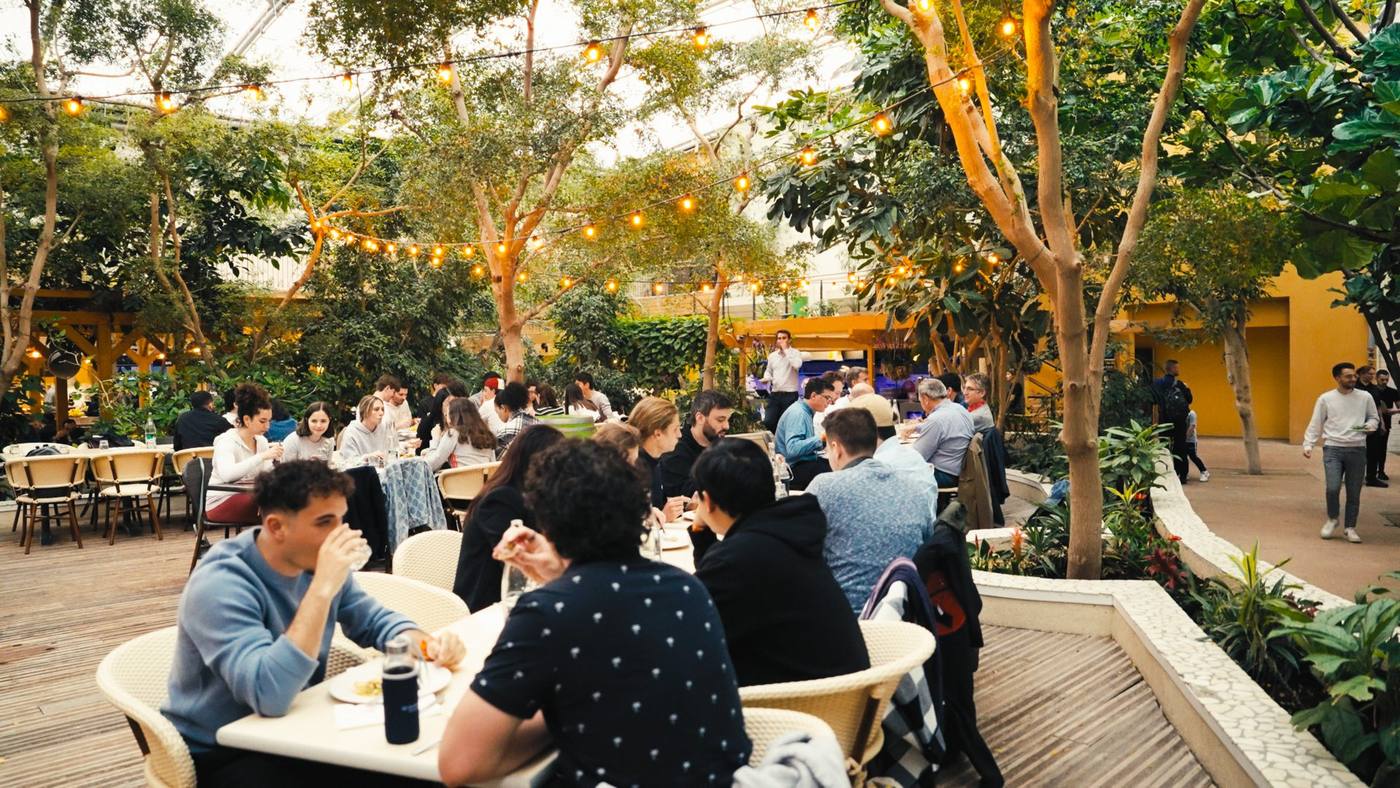
The KPMG seminar at Center Parcs Lac d’Ailette, with local suppliers
For the France-wide seminar of one of KPMG’s Business Units, we brought together 900 people over four days. We built strong partnerships with local suppliers and coordinated the shuttle runs for participants’ arrivals and departures.
Writing your criteria into the specifications means you receive comparable proposals: our event specification template helps you structure your expectations.
To go further: our ideas for reducing a corporate event’s impact, and our levers for a lower-footprint corporate retreat.
Choosing sustainable event suppliers: frequently asked questions
A third-party label is solid proof, but it does not tell the whole story. A local caterer without a label can offer a seasonal menu and a solution for unserved dishes: it is better to look at both the labels and the practices written into the quote.
Three elements are enough: the exact name of the label with its scope and date, the practices written into the quote, and the data the supplier can share after the event. What is written down is easy to check on the day.
Yes. As options, Weevup offers a coffee break served by an inclusive business, welcome packs prepared by an ESAT, a social caterer for a buffet lunch, and a partner charity that collects unserved meals. You choose the options that suit you.
Your suppliers, chosen with Weevup
Weevup, an event agency founded in Paris in 2015 and based in Le Vésinet (Yvelines), organises your corporate retreats, conferences and evening events in Paris, in the Île-de-France region, across France and abroad. EcoVadis silver medal (June 2026).